

Determining whether your automotive battery jumper cables are too short is crucial for effective and safe jump - starting operations. As a supplier of automotive battery jumper cables, I've witnessed firsthand the challenges and risks associated with using cables that are not of the appropriate length. In this blog, I'll share some key indicators that can help you figure out if your jumper cables are too short.
Physical Distance Between Vehicles
One of the most obvious signs that your jumper cables might be too short is the physical distance between the two vehicles involved in the jump - start process. When jump - starting a dead battery, you typically need to connect the cables from a donor vehicle with a charged battery to the vehicle with a dead battery.
In an ideal situation, the two vehicles should be parked close to each other without touching. However, factors such as parking layout, obstacles in the environment, or limited space can make it difficult to position the vehicles in close proximity. If you find that even when you park the vehicles as close as possible, you can't reach the battery terminals of both vehicles with the jumper cables, then it's a clear sign that the cables are too short.
For example, in a crowded parking lot or a narrow driveway, it might be challenging to get the vehicles close enough. Modern vehicles also have different battery locations. Some cars have their batteries installed in the trunk or under the rear seat, making it more difficult to reach. If your jumper cables fall short in such scenarios, you need to consider getting longer ones.
Cable Tension and Security
Another important aspect is the tension and security of the cable connections. When the cables are too short, you may have to stretch them to their maximum to reach the battery terminals. This stretching can cause excessive tension on the cables and the terminal clamps.
Excessive tension can lead to several problems. Firstly, it can cause the clamps to come loose during the jump - start process. A loose connection on either the positive or negative terminal can result in poor electrical conductivity, which means the battery may not receive enough charge to start the vehicle. It can also cause arcing, which is not only dangerous but can damage the battery terminals and the cables themselves.
Secondly, the constant pulling on the cables due to short length can put stress on the internal wiring of the cables. Over time, this stress can cause the wires to break or fray, reducing the cable's lifespan and effectiveness. If you notice that you have to pull the cables tightly to make the connections and that the clamps seem to be at risk of coming off, it's a strong indication that your cables are too short.
Maneuverability and Accessibility
Good jumper cables should allow for easy maneuverability and accessibility. When using the cables, you need to be able to connect and disconnect the clamps to the battery terminals with relative ease. If the cables are too short, you may find it difficult to maneuver them around the engine compartment or other components of the vehicle.
In some cases, you may need to contort your body or use tools to try and reach the battery terminals. This not only makes the jump - start process more time - consuming but also increases the risk of accidentally touching other metal parts in the engine compartment, which can lead to electrical shock or short - circuits.
For instance, if you have to bend or twist the cables at awkward angles just to connect them to the battery, it's a sign that they are not of the right length. Longer cables provide more flexibility, allowing you to position the clamps accurately on the terminals without having to struggle.

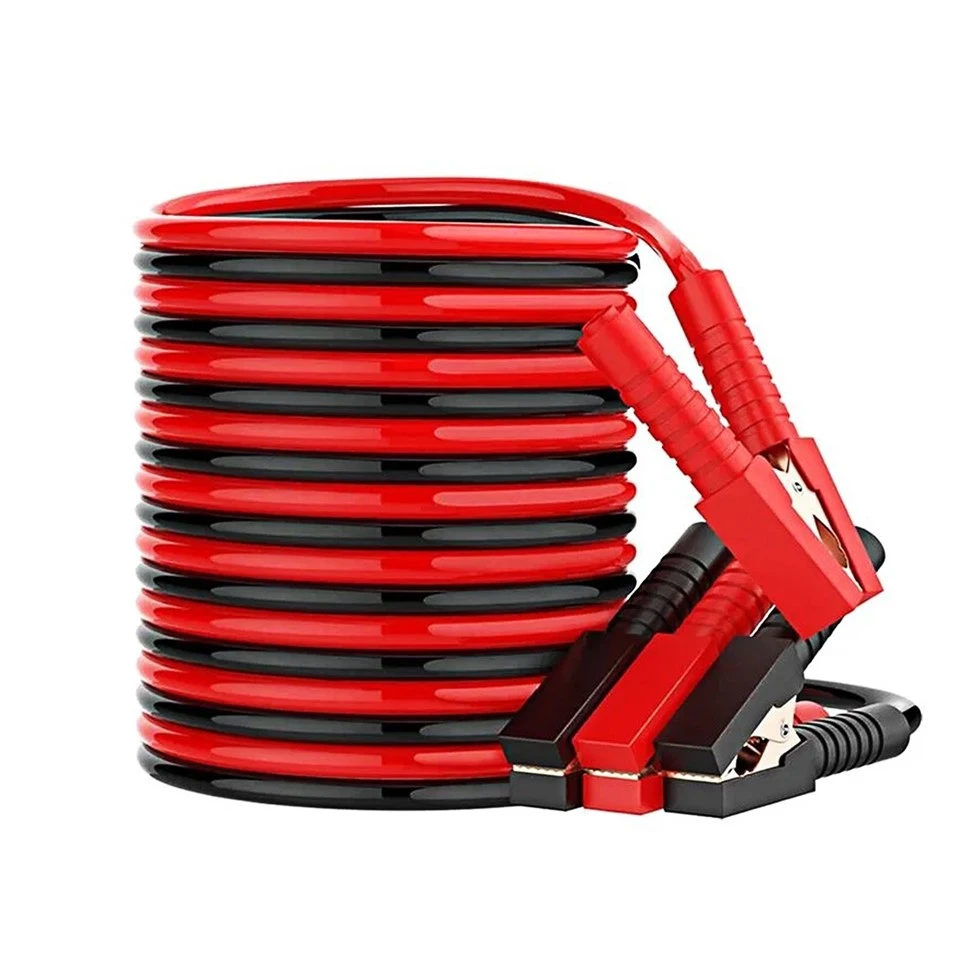
Compatibility with Different Vehicles
As a supplier of automotive battery jumper cables, I understand that different vehicles have different requirements. Trucks, SUVs, and large vehicles often have bigger batteries and more complex engine layouts compared to smaller cars.
If you mainly use your jumper cables for smaller cars and then try to use them on a larger vehicle, you may find that the cables are too short. Trucks, in particular, may have batteries located in hard - to - reach places under the hood or in the rear of the vehicle. Using short cables on a truck can be extremely challenging and may even be impossible in some cases.
We offer a range of products, including the Best Heavy Duty Jumper Cables for Trucks, which are designed to be long enough to reach the batteries of large vehicles. These cables are not only long but also heavy - duty, capable of handling the higher electrical demands of trucks.
Impact on Electrical Performance
The length of the jumper cables can also have an impact on their electrical performance. When electricity flows through a cable, there is a certain amount of resistance. The longer the cable, the higher the resistance. However, this does not mean that shorter cables are always better.
If the cables are too short, the high - current flow during the jump - start process can cause overheating due to the concentrated resistance over a short length. Overheating can damage the insulation of the cables and reduce their lifespan. Moreover, if the short cables cannot make a proper connection due to the distance issue, the electrical transfer from the donor battery to the dead battery will be inefficient, which can lead to a failed jump - start.
On the other hand, longer cables, when properly designed with the right gauge (thickness) of wire, can minimize the resistance and ensure a smooth flow of electricity. We offer cables that are engineered to balance length and electrical performance, ensuring that you get the best results when jump - starting your vehicle.
Cost - Benefit Analysis
When considering the length of your jumper cables, it's also important to do a cost - benefit analysis. Shorter cables are generally cheaper, but they may not be suitable for all situations. If you find yourself constantly struggling with short cables and having to call for professional help or use alternative jump - starting methods, the cost savings on the cables may be offset by the additional costs incurred.
Our Car Jump Start Cable Price page provides a variety of options at different price points. You can find cables that are long enough for your needs without breaking the bank. By investing in slightly longer cables, you can ensure that you are prepared for any jump - start situation, which can save you time and money in the long run.
Portable Battery Charger Compatibility
In addition to traditional jump - starting, many people are now using portable battery chargers in combination with jumper cables. Our Jumper Cables Portable Battery Charger products are designed to work together seamlessly.
However, if your jumper cables are too short, it can limit the effectiveness of using a portable battery charger. You need to be able to connect the cables to both the charger and the vehicle's battery with ease. Short cables may prevent you from positioning the charger in a convenient location, or they may not be able to reach the battery terminals when the charger is placed in a safe and accessible spot.
Conclusion
In conclusion, there are several ways to determine if your automotive battery jumper cables are too short. From physical distance and cable tension to maneuverability, compatibility with different vehicles, electrical performance, cost - benefit, and portable battery charger compatibility, all these factors play a role in assessing the suitability of your cables.
As a supplier of high - quality automotive battery jumper cables, we are committed to providing you with the best products to meet your needs. Whether you need cables for small cars, large trucks, or in combination with portable battery chargers, we have a wide range of options available.
If you are interested in purchasing our automotive battery jumper cables or have any questions about the right length and type of cables for your specific requirements, please feel free to contact us for a procurement discussion. We are here to help you make the best choice for your vehicle's jump - starting needs.
References
- "Automotive Electrical Systems" by John H. Kershaw
- "The Complete Guide to Car Maintenance" by Tom Torbjornsen